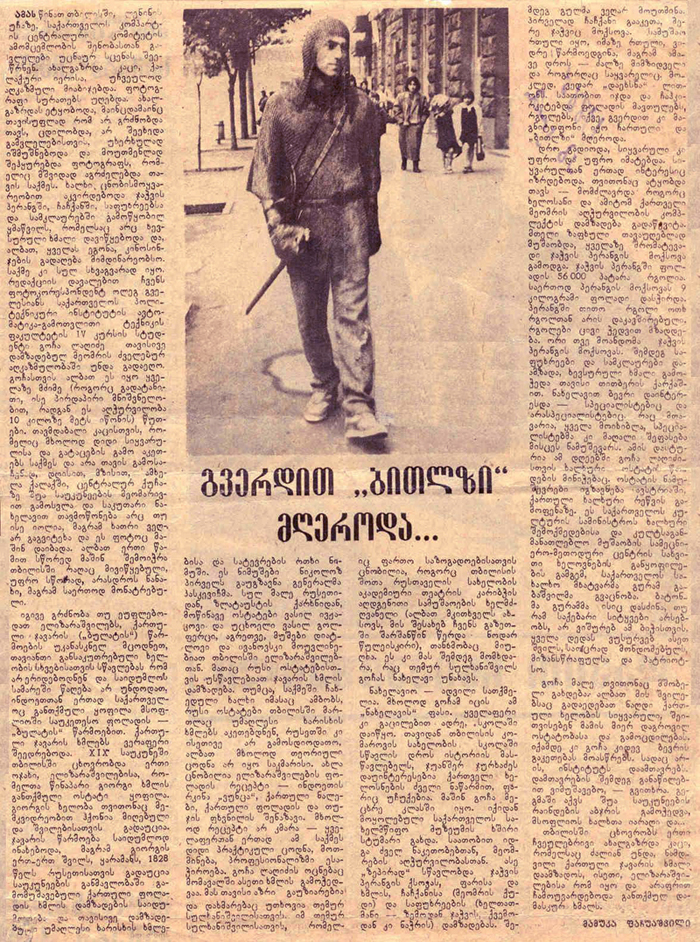
გოჩა ლაღიძე
მსოფლიო პრესის ფურცლებზე


ლითონში ნაჭედი ლეგენდა
"24 საათი". მზეხა მახარაძე. თბილისი. 18 დეკემბერი. 2004.


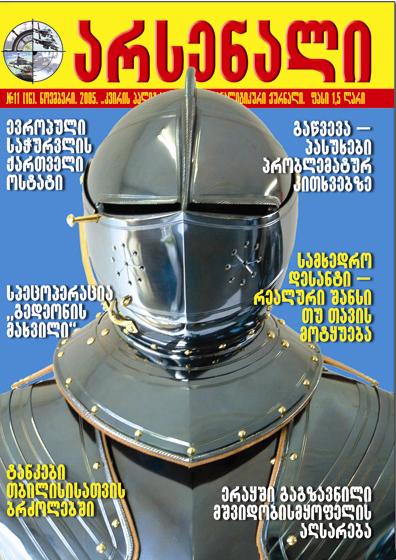
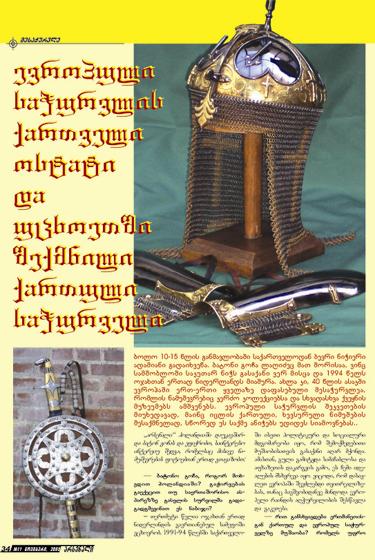
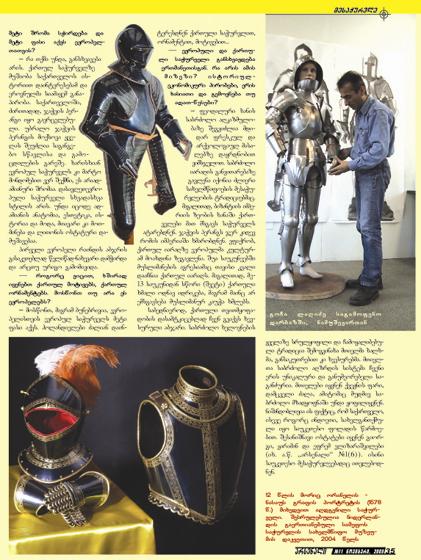
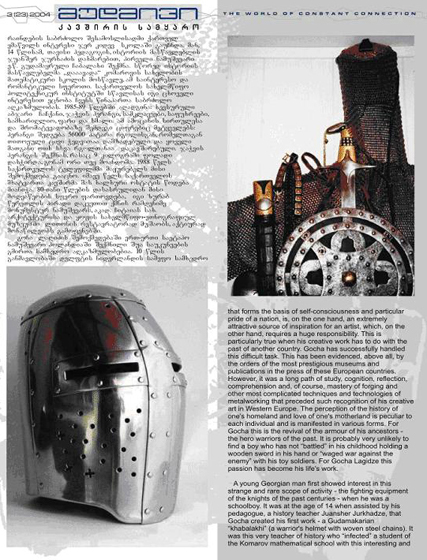
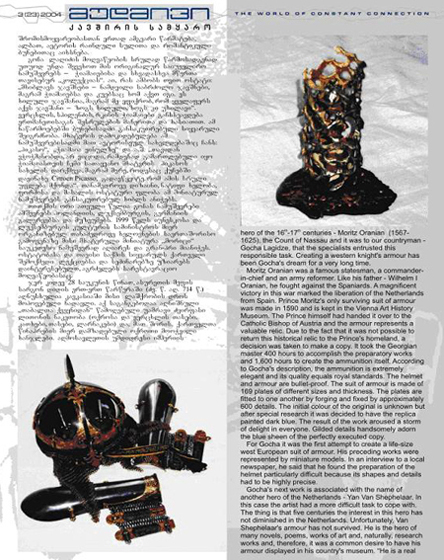
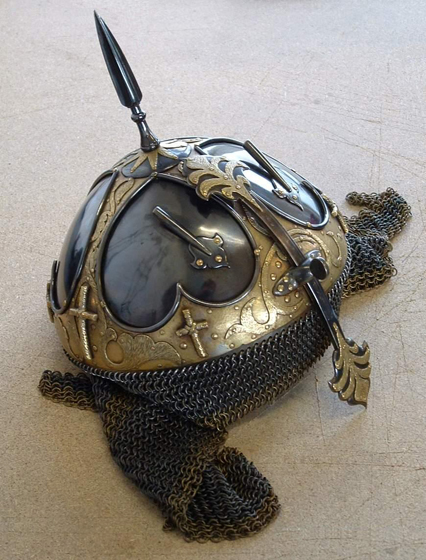
      აქ ყოველ დეტალს ორმაგი გრავირებული ღარი დაჰყვება, რაც საერთო ფორმის სიბრტყობრივ გააზრებაში შეიძლება მივიჩნიოთ მხატვრულ დეკორად. მუზარადის კაუჭები, მოქლონები, ქამრის დეტალები მოოქროვილია, რასაც სამხედრო აღკაზმულობის მოლურჯო გრადაციაში გრაციოზული ელემენტები შეაქვს.
      ლეგენდარული მხედართმთავრის ერთადერთი აბჯრის ორიგინალი, რომელიც 1590 წლით თარიღდება, ვენის ხელოვნების ისტორიის მუზეუმის რელიქვიაა. ნიდერლანდების ისტორიულ ქრონიკებში გაბნეული ლეგენდებიდან ვიგებთ, რომ ნასაუს გრაფ მორიც ორანელმა საკუთარი აბჯარი სიცოცხლეშივე უსახსოვრა ავსტრიის კათოლიკური ეკლესიის ეპისკოპოსს. გავა თითქმის 400 წელი და ამ იკონოგრაფიული ექსპონატის ასლს ქართველი მესაჭურვლე გამოჭედავს, ამ პრეცენდენტს კი ევროპული პრესა ასე გამოეხმაურება: „ათი წლის მანძილზე მთელს ნიდერლანდებში არ გამოჩნდა პიროვნება, რომელიც პრინც მორიცის 1590 წლის დროინდელი საბრძოლო საჭურვლის ბადალს დაამზადებდა. ეს შესძლო ქართველმა გოჩა ლაღიძემ, რომელიც ბატონ იან პიტ პაიპეს თქმით, „ჭეშმარიტი პროფესიონალია. მისი ნამუშევარი ნამდვილი ხელოვნებაა. საოცარია ამ ხელოვანის შემოქმედებითი ძალის საიდუმლოება, ამოუწურავი შესაძლებლობანი, ინტუიცია, ისტორიის, ადამიანის ანატომიის ცოდნა.“
      შუასაუკუნეების გმირის ამ რარიტეტს თავისი ბედი და ბიოგრაფია აქვს, რომელიც მართავს მისსავე მომავალს... თანამადროვეთაგან კი როგორც ორიგინალი, ასევე მის მიხედვით შექმნილი ნიმუში წარსულის თანაგანცდას აღძრავს. და მაინც, რა განასხვავებს ასლსა და ორიგინალს?
      – განსხვავება ორიგინალსა და ასლს შორის ისაა, რომ ძველი შავი ფერისაა, ახალი, ანუ ჩემი ასლი – ლურჯი. – მეუბნება მესაჭურვლე გოჩა ლაღიძე, – მრავალი სინჯებისა და მოლაპარაკებების შემდეგ გადაწყდა, რომ ასლი მუქ ლურჯად მოელვარებულიყო... დელფტის მუზეუმმა მოითხოვა ორიგინალის ზუსტი კოპირება და ის უნდა ყოფილიყო ხარისხიანი. ოფიციალურ დონეზე გაფორმდა ოცგვერდიანი კონტრაქტი, თითქმის წლამდე გაგრძელდა ეს პროცესი, დეტალების შეთანხმება. პირობების შესრულებას მთელი სიზუსტით მოითხოვდნენ. პროექტი ითვალისწინებდა ოთხ დამოუკიდებელ ხელშეკრულებას. პირველი ხელშეკრულება ეხებოდა მუზარადის დამზადებას, მეორე – ყელის, მკერდისა და ზურგის აბჯრების, ხოლო დანარჩენი კი მხრების, მკლავების, ხელთათმანებისა და ფეხის საჭურვლის შექმნას.
      – აქვე საინტერესოა, პრინც მორიც ორანელის ეს უნიკალური აბჯარი როგორ იკითხება ორიგინალში – იყო თუ არა ექსპონატი თავდაპირველად დაზიანებული, რესტავრაცია-კონსერვაციის ეტაპი თუ გაიარა, ან თუ აკლია მას რაიმე დეტალი?
      – ეს ძალიან მნიშვნელოვანია, რადგან ორიგინალში საჭურველს ზურგის ნაწილი და მარჯვენა საბრძოლო ხელთათმანის საჩვენებელი თითი აქვს დაკარგული. ვინაიდან შეკვეთა ითვალისწინებდა ზუსტი ასლის გადაღებას, ეს დეტალები და ნაწილები ასლსაც უნდა ჰკლებოდა. ჯერ ფოტოებით ვიმუშავე და შემდეგ შევისწავლე ორიგინალი, ორასამდე ესკიზი გაკეთდა ფოტოსურათების საფუძველზე. წარმოიდგინეთ, მეთვალყურეების თანდასწრებით დაიშალა ორიგინალი – თეთრი ხელთათმანებით, ვიდეოკამერით ვსწავლობდი, ეს იკონოგრაფიული ექსპონატია და ათი დღე მოვუნდი, რომ ყველაფერი მილიმეტრებში გამეზომა.
      – როგორ მიმდინარეობდა ექსპერტიზის პროცედურა? რა ინტენსივობით გადიოდა ასლი ტესტირებას?
      – მოდიოდნენ ექპერტები, ამოწმებდნენ როგორ ვმუშაობდი, კონტრაქტით ასე იყო გათვალისწინებული, სამ დღეში მომდიოდა დასტური, რომ შემეძლო გაგრძელება. ეს დიდი მოვლენა იყო თვითონ ჰოლანდიელებისთვისაც, რადგან ორიგინალი თითქმის ოთხასი წლის მანძილზე, პირველად ათი წლის წინ ჩამოიტანეს ნიდერლანდებში ქალაქ დელფტის სამხედრო მუზეუმში და თურმე მაშინ დაიბადა იდეა შექმნილიყო საჭურვლის ასლი, რომელიც ჰოლანდიაში სამუდამოდ დარჩებოდა. იუნესკოდან ვენეციის სამხატვრო აკადემიის პროფესორი სამჯერ იყო ჩემთან სახელოსნოში, თავიდანვე ვიცოდი, რომ რაღაც ძალიან მნიშვნელოვანს ვაკეთებდი. ცხრა თვე ვმუშაობდი და საბოლოოდ ამ საჭურველმა აღტაცებაში მოიყვანა ჰოლანდიელები. თბილისში პირველად ჩამოვიტანე ეს ექსპონატი, რეაქცია აქაც ჰოლანდიელების მსგავსია – გამოფენაზე ყველა დიდი ინტერესით აკვირდებოდა.
      – როგორი სტანდარტებით არის დამზადებული პრინცის საჭურველი და რა ღირსებები გააჩნია მას?
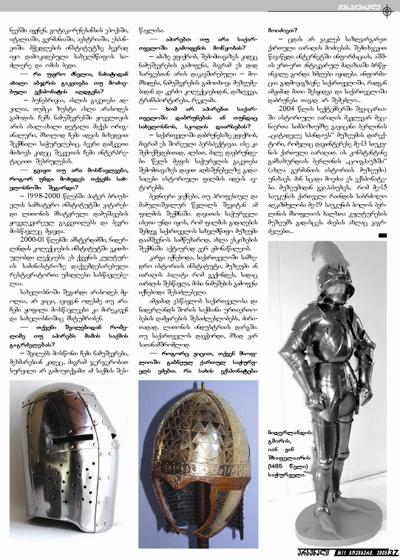
      – საერთოდ, ევროპელი რაინდები სხვადასხვა დანიშნულების საჭურველს ატარებდნენ: საზეიმო, საასპარეზო, საბრძოლო. პრინც მორიცის საჭურველს, თავისი დამზადების ხარისხით, სამეფო საჭურვლის ღირსება გააჩნია. იგი ზედმიწევნით გრაციოზული და ესთეტურია. როგორც აღვნიშნე ეს აბჯარი საბრძოლო დანიშნულებისაა, მუზარადი და მკერდის ნაწილი ტყვია გაუმტარი იყო. ოსტატის მიერ დამზადებული საჭურველი გადიოდა ტესტირებას მუშკეტის ტყვიის რამოდენიმე მეტრიდან სროლით. როგორც წესი, ნატყვიარი აღარ სწორდებოდა იმ მიზნით, რომ მას ხარისხის ნიშნის დანიშნულება ჰქონოდა. მორიცის საჭურველზე ანალოგიური ტესტირების ნიშნები აღინიშნებოდა. შესაბამისად, ასლში ე.წ. ხარისხის ნიშანი გათვალისწინებულია. მთელი საჭურველი შიგნიდან ტყავის ღვედებით უკავშირდება ერთმანეთს, რაც საშუალებას აძლევდა რაინდს ბრძოლის დროს მასში მოხერხებულად ეგრძნო თავი.
      – ალბათ, ერთმანეთისგან არა მარტო დამუშავების ტექნიკით განსხვავდება ქართულ და ევროპულ სამხედრო აღკაზმულობაზე მუშაობა.
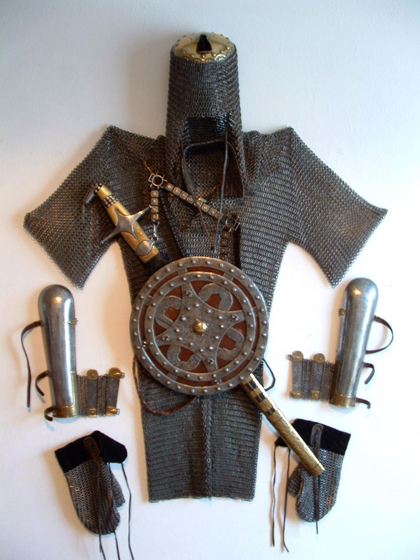
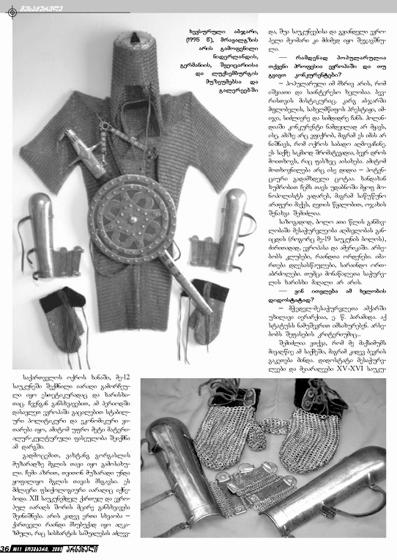
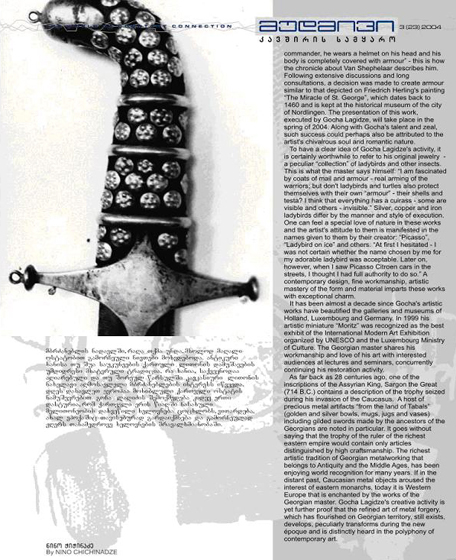
      – განსხვავება ნამდვილად არის. ქართულ საჭურველზე ჩემი მუშაობა საქართველოს ისტორიით დაინტერესებამ და ეროვნულმა სიამაყემ განაპირობა. საქართველოში, ძირითადად, ჯაჭვის პერანგი იყო გავრცელებული. უბრალო ჯაჭვის პერანგის მოქსოვა ყველას შეუძლია საგანგებო სწავლისა და გამოცდილების გარეშე. ხარისხიან ევროპულ საჭურველს კი მარტო მონდომებით ვერ შექმნი, ეს არაადამიანური შრომაა. დასავლეთევროპული საჭურველი სხვადასხვა სტილის არის და აქვე უნდა იცოდე ადამიანის ანატომია, ესთეტიკა, ისტორია, დამზადების ტექნიკა, განვითარების ქრონოლოგია. მთავარი კი ლითონის ოსტატური დამუშავებაა. პირველი ევროპელი რაინდის აბჯრის გასაკეთებლად წელიწადნახევარი დამჭირდა. ფეოდალური ხანის საბრძოლო აღკაზმულობაზე შეგვიძლია მდიდარ ფრესკულ და არქეოლოგიურ მასალებზე დაყრდნობით ვიმსჯელოთ. საბრძოლო იარაღის განვითარებაზე სახელმწიფოების მესაჭურვლეობის ტრადიციებმაც იქონია ძლიერი გავლენა. მაგალითად, ბიზანტიის იმპერიის ზეობის ხანაში ქართველები მათ მსგავს საჭურველს ატარებდნენ. ჯაჭვის პერანგს ჯერ კიდევ, რომის იმპერიაში ხმარობდნენ. ვფიქრობ, ქართულ იარაღზე ევროპულმა კულტურამ მოახდინა ზეგავლენა, შუა საუკუნეებში კი მუსლიმანების აგრესიამაც თავისი კვალი დააჩნია. მაგალითად, XIII საუკუნიდან სწორი, ანუ შვეტი ქართული ხმალი ოდნავ იდრიკება, მაგრამ ის მაინც არ ემსგავსება მუსულმანურ კაუჭა ხმლებს. ჩვენ გვაქვს ხევსურული აბჯარი. საბრძოლო ხელოვნების ყველაზე სრულყოფილი და ჩამოყალიბებული ტრადიცია შემოგვინახა მთიელმა ხალხმა, განსაკუთრებით კი ხევსურებმა. მთიელთა საბრძოლო აღზრდის სისტემა ჩვენი ერის უნიკალურია. ფარეშიანი ჯაჭვის პერანგის ქსოვის ტექნიკა ერთ-ერთი უძველესი და ურთულესი ნიმუშია, ქსოვის ასეთი ტრადიცია საქართველოში მეხუთე საუკუნიდან არსებობს. ამგვარი ქსოვის ტექნიკით დამზადებულ ჯაჭვის პერანგი 56 000 პატარა რგოლისგან შედგება, თითო რგოლი დაკავშირებულია ოთხ რგოლთან, რგოლები ცივი ჭედვის ტექნიკით მზადდება და თითოეული რგოლი დამოქლონებულია (შეკრულია) პატარა ფარეშით. მნიშვნელოვანია ის ფაქტიც, რომ საქართველოში, თითოეული ჯაჭვის რგოლზე ოსტატი საკუთარ ნიშანს ასვამდა , რაც ნამუშევრის ხარისხის მაჩვენებელი იყო. მთიელები იყვნენ ქვეყნის ფარი, დამცველი ძალა, ამიტომაც მუდმივ საბრძოლო მზადყოფნაში უნდა ყოფილიყვნენ. შემთხვევითი არ არის ის ფაქტიც, რომ საქართველო, ისევე როგორც ინდოეთი, სახელგანთქმული იყო საუკეთესო ფოლადის წარმოებით. შესანიშნავი ოსტატები იყვნენ გიორგი, ყარამან და ეფრემ ელიზარაშვილები. ისინი საუკეთესო მესაჭურვლეებადაც ითვლებოდნენ. საქართველოს ოქროს ხანაში, XII საუკუნის იარაღი გამორჩეული იყო ესთეტიკურადაც და ხარისხითაც. ჩვენგან განსხვავებით, ამ პერიოდში დასავლეთ ევროპაში გაცილებით სტაბილური პოლიტიკური და ეკონომიკური ვითარება იყო, ამიტომ უფრო მეტი მატერიალურ-კულტურული ფასეულობა შეიქმნა ამ დარგში. გადმოცემით, ვახტანგ გორგასლის მუზარადზე მგლის თავი იყო გამოსახული. ჩემი აზრით, თვითონ მუზარადი უნდა ყოფილიყო მგლის თავის მსგავსი. ეს მძლავრი ფსიქოლოგიური იარაღიც იქნებოდა. XII საუკუნემდელ ქართულ და ევროპულ იარაღებს შორის მცირე განსხვავება შეინიშნება. არის კიდევ ერთი სხვაობა – ქართველი რაინდი მსუბუქად იყო აღკაზმული, რაც სისხარტის საშუალებას აძლევდა, შუა საუკუნეებისა და გვიანდელ ევროპელ მეომარს კი მძიმე აბჯარი ეცვა.
      – საერთოდ, წარსული ცხოვრების ეს საბრძოლო სამუზეუმო ექსპონატები თავისი არსით მნიშვნელოვან ინფორმაციას იძლევა არა მარტო სამხედრო პოლიტიკისა და სტრატეგიის ისტორიული არქივისათვის. ამ აღკაზმულობაში არის მხოლოდ იმ ეპოქისეული ნიუანსები, რაც ალბათ, ისტორიოგრაფებმა შეუძლებელია თავის დოკუმენტებში დააფიქსირონ.
      – კარგ აბჯარში მფლობელის, სახელმწიფოს პრესტიჟი, იმიჯი, სიძლიერე და სიმდიდრე ჩანს. დიდოსტატი მესაჭურვლეები და მეიარაღეები XV-XVI საუკუნეებში იყვნენ, გოთიკა-რენესანსის ეპოქაში, გერმანიაში, ავსტრიაში, ესპანეთში და მათზე ბევრად იყო დამოკიდებული სახელმწიფოს სიძლიერე და ომის ბედიც. საბრძოლო აღკაზმულობა – ხმლები, მუზარადები, ჯაჭვის პერანგები კულტურული ფასეულობაა. როგორ გითხრათ, აი, ხევსურული საბრძოლო აღჭურვილობა, ეს არის ჩვენი იარაღი, რომელმაც ჩვენ გადაგვარჩინა. დაგვრჩა ისტორიული ნიმუშები, რომლის ნაწილიც გასულია საქართველოდან, მაგრამ, ეს ტრადიცია დღეს დაკარგულია, მას გამოყენებითი ფუნქცია აღარ აქვს. მე მხვდა წილად, პირველი ვყოფილიყავი ხევსურული ჯაჭვის პერანგის აღდგენაში. ეს ძალიან საჭიროა მომავალი თაობისთვის, რადგან ნახონ, მათ წინაპრებს როგორი ტანსაცმელი ეცვათ, როგორი იყო გამოხატული ერის მატერიალურ კულტურაში ხასიათი. იაპონელები დღეს იბრუნებენ თავიანთ იარაღს, რომელიც ომის დროს გაიზიდა მათი მუზეუმებიდან და იცით, რატომ? – ეს მათი შინაგანი მოთხოვნაა. ყველა ქვეყანას, ისევე როგორც ადამიანს, მატერიალური კულტურის შეფასების საკუთარი სისტემა აქვს და ასევე, ინდივიდუალურად განსაზღვრავს, რა უფრო სჭირდება.
      – თქვენ მსოფლიოს სხვადასხვა მუზეუმებში გაბნეულ ქართულ საჭურველ-იარაღის უნიკალური ექსპონატების აქტიურ მოკვლევასა და დაფიქსირებაზე ზრუნავთ. რა რაოდენობის იკონოგრაფიული მასალები მოიძიეთ?
      – რაოდენობაზე რა გითხრათ, მაგრამ შემთხვევით წავაწყდი ინტერნეტში ინფორმაციას, აშშ-ის ერთ-ერთ ანტიკვარულ მაღაზიაში ბრწყინვალე გორდა ხმლები იყიდება. ინფორმაცია გადმოვაგზავნე საქართველოში, რადგან იმ დროს მათი შესყიდვა და საქართველოში დაბრუნება თავად არ შემეძლო. 2004 წლის სექტემბერში შვეიცარიაში გავიცანი ბერლინის „ციტადელე სპანდაუს“ მუზეუმის დირექტორი, რომელიც დავაინტერესე XIII საუკუნის ქართული იარაღით. ის კონსტანტინე გამსახურდიას ბერლინის „ცოიგჰაუზში“ (ახლა გერმანიის ისტორიის მუზეუმი) უნახავს. მან სცადა მოეძია ეს ექსპონატები. მუზეუმიდან გვიპასუხეს, რომ XV საუკუნის ქართველი რაინდის საბრძოლო აღკაზმულობა XIX საუკუნის ბოლოს თურმე გადასცეს ბერლინის მსოფლიოს ხალხთა კულტურების მუზეუმს. ჩემი შესაძლებლობებიდან გამომდინარე, ძიებას ახლაც ვაგრძელებ. მე ნიდერლანდებში 10 წელზე მეტია რაც ვცხოვრობ. ჰოლანდია ის ქვეყანაა და ჰოლანდიელები ის ხალხია, რომელმაც მე და ჩემი ოჯახი სიყვარულით მიგვიღო. მე მიყვარს იქ ყოფნა, თუმცა ორი სამშობლო არ არსებობს. „ჩვენებურების“ ამ გამოფენამ ჩემს სამშობლოში ჩამომიყვანა და ეს ჩამოსვლა ჩემთვის იმით იყო მნიშვნელოვანი, რომ საზღვარგარეთ მცხოვრებმა ქართველმა ხელოვანებმა ამ ექსპოზიციით გამოვხატეთ ჩვენი მოკრძალება კათოლიკოს-პატრიარქის აღსაყდრების 30 წლის იუბილესადმი.


Art without borders
The Messenger, Tbilisi, 24 juni 2005, By Nino Kopaleishvili


      Georgian goldsmith Gotscha Lagidze is one of those artists who believe that art does not have borders. Having worked on traditional Georgian weapons and armor since he was a teenager, Lagidze reproduced a suit of armor that belonged to Prince Maurits of Nassau in 1998 for the Delft Royal Netherlands Army and Arms Museum. Calling it his "favorite work," Lagidze keeps another masterpiece of Prince Maurits at his delightful Dutch-style house in Roosendaal, in the south of the Netherlands. Lagidze has been living in the Netherlands since 1994 with his wife Lela and three children Giorgi, 17, Lasha, 15, and Sophia, 9. Lagidze has been cooperating with different museums in the Netherlands over the years and in 2003 he made a reproduction of the chain mail of Jan van Schaffelaar, Holland's national hero from the 15th century. "The work on it continued for three-four years. To help raise funds, it was decided to make the armor in the style that St. George dressed. It was important not to violate historical rules," he states.
      In 1999 Lagidze received first prize at the international forum in Luxembourg for modern art in steel. "I took my miniature to the forum before it was completed. The event was really important," he said.
      In addition to working on different projects Lagidze also teaches at Amsterdam State University. However, he admits there are not many students who are interested in work on steel, mainly for commercial reasons.
      "Such things are difficult to do and this art is disappearing gradually," he says. "But it is such an intellectual discipline." Now he plans to try his hand in other fields more available to public. "Now I am designing street lamps which are for the public. The first ten copies will be produced soon," he says.
      Chain mail of the famous Georgian King
      Earlier this year, Lagidze received an offer from the Georgian playwright Dato Turashvili to design chain mail for a film about Georgia's famous king Davit Aghmashenebeli. "Probably I will travel to Tbilisi. It is important to do it in Tbilisi," he says. "The chain mail of Davit Aghmashenebeli is not on a fresco. That is why I want to do it not only for the movie, but for a museum." His love for designing old war equipment exists hand in hand with his love of Georgian history. He was particularly interested in Khevsurian armor and often traveled to the region to study this equipment in the years 1985-88. "Everything started from my teacher Juansher Jurkhadze, who taught me history," he says.
      "Once I had a knife that I made myself. He took it and said it was no good. The next day he presented me with a little sword," he said. Later, Lagidze happened to visit his teacher's home and was amazed at the collection of old Georgian equipments.
      "I decided to do steel chain mail and I did it ... probably this man got me on the right track," he adds.
      Looking back to his home country
      "Georgia is my home country and nothing can change that," says Lagidze, adding, however, that there are many things in Dutch society that he would like to see transferred to Georgia. Lagidze and his family often watch Georgian television channels and search for news on the internet about Georgia. "I am sympathetically disposed to the events taking place in the country now. We are happy about all the good changes happening in my country," he declares. Lagidze, who participated in the two civil wars in the 1990s in Abkhazia and South Ossetia, says that the defeat was the final straw which drove him to leave the country.
      "Defeat in Abkhazia was a great disappointment and this became one of the reasons why I left Georgia," he says. "In my opinion there was certainly a mistake as this should not have happened but I do not know how it started."
      Several months ago, Lagidze, who is now a citizen of the Netherlands, applied for dual citizenship and hopes to become a citizen of Georgia again.
      "I really want to get it, but I am trying not to think what the answer will be," he said.


Gotscha Lagidse makes statue of Dutch hero Jan van Schaffelaar
Exhibition at Nairac Museum in Barneveld, by Drs. Priscilla van Leeuwen. Barneveld, 12 May 2004


      Gotscha Lagidse is a Georgian artist and armourer who has been living and working in Holland for the past ten years. He has made a beautiful statue for the 15th century Dutch hero Jan van Schaffelaar. The statue was commanded by the Nairac Museum in Barneveld, a bustling market place in the centre of Holland.
      In Dutch history one period – between approximately 1350 and the end of the 15th century – is known as the ‘war between the Hoeken and the Kabeljauwen’ (the Hooks and the Codfishes). Both parties were composed of often changing factions of noblemen and towns in Holland and Zealand. Jan van Schaffelaar was a landowner, a squire of no great importance or wealth. He was probably in the service of Maximilan of Austria, so he belonged to the party of the Kabeljauwen. His small army consisted of about 20 cavalary men. They were instructed to intercept the food transports on their way to the beleaguered town of Utrecht, which was in the hands of the Hoeken. On the sixteenth day of July 1482 a certain number of horsemen, coming from Roosendaal, captured the tower and church of Barneveld. Soldiers form the neighbouring towns of Amersfoort and Nijkerk besieged the church tower were Jan and his men had taken refuge. The soldiers – Hoeken – on the ground demanded that they throw Van Schaffelaar from the tower. To this Jan replied: ‘Beloved men, one day I have to die anyway; I don not want to cause you any trouble’. He climbed onto the battlements of the tower, raised his arms aloft and jumped. He survived the fall but was killed by his enemies.
      This minor episode in the long guerrilla warfare was mentioned in a chronicle of that time. His deed of self-sacrifice so spoke to the imagination that during the following centuries he became a well-known hero.
      The small museum Nairac is situated in the centre of Barneveld, at the foot of the church tower from which Jan van Schaffelaar leaped to his death. As Jan left nothing behind but the story of his heroic deed the museum has to recreate his story with pictures, weapons from the period or replica’s. The curator wanted to illustrate the story with a type of armour that Jan van Schaffelaar could have worn. As there was no original late 15th century armour available the museum wanted to have a historically correct new armour made.
      Through a newspaper article attention was drawn to Georgian-born and raised Gotscha Lagidse. He was already well known in his own country and was now making a name for himself in Holland. He had already made a replica of the armour of Maurits, prince of Orange, and the head of the new Dutch Republic in the 17th century. The original is in the Museum in Vienna.
      As a model for the armour a beautiful painting by Friedrich Herlin, c.1460, was chosen depicting St. George and the dragon. The knight in the painting is wearing a fine example of the best quality armour worn at the time. It is in what is know ‘Italian export’ style. This style of armour was made by Italian armourers, with Germanic and northwest European features incorporated, to suit their clients. This armour style was popular throughout Northern Europe, even as far as England.
      Gotscha worked for nearly 2000 hours to hammer and burnish the steel plates into the required form. He had to transform a two-dimensial picture into a three-dimensional object and it took al his long experience as a master- armourer and and artist to do this. The resulting armour is splendid and gives a completely accurate impression of how Jan van Schaffelaar would have looked at the time. It now forms one of the showpieces of the museum exhibition.


Show Piece
Exhibition at Bremmer Gallery in Tilburg, Newspaper article (Brabants Dagblad, Visual Art),
by A.K. Beekman, 7th September 2000. (translation)


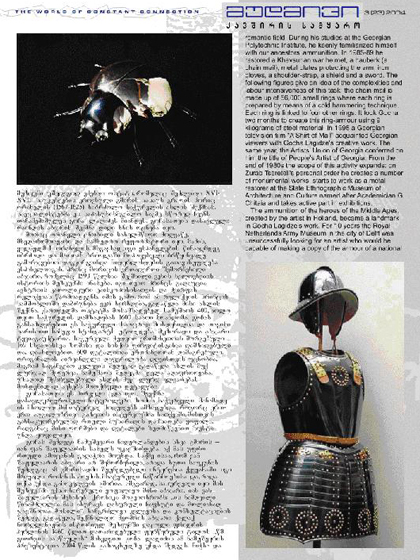
      "Picasso is the name of this Ladybird. It is one of my favourite pieces. This name came to me whilst I was making it. So it is more a kind of feeling. It is true that Picasso is my favourite artist. Like me, he has worked in many styles. This ladybird also means a new style for me. Indeed, I have hesitated for a moment if it would be right to call it after Picasso, but when I saw that Citroën Picasso driving around, I knew for sure it would be all right. I love ladybirds. I have a special relationship with nature and the ladybird is the protector of flowers and plants; a very courageous creature.
      In 1994 I came to the Netherlands. Georgia is my mother country. There the ladybird is called Chia-Maia. Like ladybird (in Dutch: lieveheersbeestje = creature of our Lord) a very beautiful name. When people in Georgia have lost something they also call out to the ladybirds. Then they help to search for it. As a child I was already in love with them. It is a very beautiful, kind and good creature.
      Apart from the ladybird the exhibition also shows suits of armour. I am fascinated by armour — real suits of armour, but a ladybird or a tortoise also has one. All those are visible armours. But I think everything has a suit of armour, sometimes visible and sometimes invisible.
      Four years ago for the first time I made a ladybird. Now I have ten in total. They all look different and they all have a different name. For example there is one called "Ladybird on ice". I also used various different materials for these bugs: silver, copper, brass and iron. For Picasso I used iron and silver. It is my favorite, for it is the best one from the series. Also, each one should be better than the last.
      The ladybird has been made with much skill, yes. But for me the technique is really of secondary importance. I conceive of a design in my mind and see it before my eyes. Then I just make it."


Quality mark
An article from ‘Metaalschrift’, no. 2, 2000. Ed. OOM and O+A, by L.Knoop. (translation)


      As a school child Gotscha Lagidse (34) had his fantasies about his motherland Georgia and Persian or Turkish troops, especially about the shining armoury. By order of the Delfts Army Museum Gotscha copied a cavalry suit of armour of prince Maurits.
      Gotscha copied Maurits’ suit of armour in his workshop in Den Bosch. When the Army Museum hosted the original from Vienna in 1998, Gotscha came to Delft ten times to measure and photograph all parts of the suit of armour. Then he ordered sheet metal in various thicknesses. Not stainless steel, for that was unknown in the 16th century. But Gotscha did ‘blue’ the steel, with a burner.
      Musket bullet: It took a year of thinking and working to the millimetre, but Gotscha forged a perfect replica. RTL5 filmed how Gotscha finally connected the 169 parts with hinges. In the Army Museum you will automatically meet the double of Maurits’ suit of armour: in the collection concerning the Eighty Years War (1568-1648). Like his father William of Orange, Maurits fought against Spain but he became known mostly as a military reformer. He changed troops of raw hirelings into a proper professional army.
      Maurits was not very tall, as is shown by his suit of armour. Remarkable also are the missing right index finger and back plate: just like the original. At the height of the belly flickers the dent of a bullet. A murderous attack on Maurits? Not at all. This small point just guarantees that it was a fighters’ suit of armour, not a decorative piece. Gotscha did indeed add this ‘quality mark’, but not with a musket.
      Most classical: Gotscha was fourteen years old, when he made his first helmet. After this he learned the art of gold and silver smithing. "I looked around in workshops to see how it was done." Gotscha had good eyes, for in the Netherlands there is no better weapon smith to be found. What does he do at the moment? I have made a miniature suit of armour. Out of iron, the oldest material!"


Knight’s armour from the hands of a Georgian blacksmith Gotscha Lagidse
An article from "Hephaistos", 5 June 1999


     In an improvised workshop he produced the replica of a suit of armour last year, which had been worn by Prince Maurits of Nassau 400 years ago. The original can be seen in the Art-History Museum in Vienna. On the initiative of Gotscha Lagidse this work was commissioned by the main curator of the Army and Weapon Museum in Delft Jan Piet Puype.
     The detail measurement of the original suit of armour on loan in Delft and the production of templates and models took 400 working hours alone. The actual production of the armour took 1,5000 working hours. The past of the suit of armour weighing 40 kilograms (88 lbs.) at 168 centimeters (62.2 in.) were hammered from plates of one to three millimeters (.39 to 1.18 in.). After comparison of the original, the finishing touches and the bluing with the flame were done.
     Gotscha Lagidse worked with "cold" techniques predominantly, in some cases heating was done by flame, and 800 fastening units, rings, et cetera, were used.
     His passion for the production of knights’ armour started during the schooldays of Gotscha Lagidse already when a history teacher awakened his enthusiasm for knighthood. With the help of this teacher, he produced his first work, a Georgian helmet.


The experiences of a weapon smith
Newspaper article (Delftse Courant), 16th January 1999. (translation)


     In the Netherlands Lagidse came into contact with the circle of artist-blacksmiths and soon they became aware of his talent. "I was granted to help with an exhibition in the Maritime Museum of Texel," says the 33-year-old Lagidse. "The director of the museum advised me to visit the Army Museum in Delft. I wrote them a letter and on an open day I went along with some work. Later I received a reply with the request whether I would like to make the suit of armour of prince Maurits."
     Chief curator J. Puype from the Army Museum was immediately enthusiastic about the skills of Lagidse. "For about ten years we have been wishing to have a replica made of the armour of prince Maurits, but we could not find the right smith. I had contact with the Dutch Guild of artist-blacksmiths, but nobody seemed suitable to execute this order. When I saw the work of Lagidse I knew he was our man and now, afterwards, I can say he is the best one I know."
     The former military garage of Den Bosch was made into a smithy for Lagidse. The anvil he received from the Delfts museum, the other tools were a gift from a rich collector of suits of armour.
     The period between receiving the order and the delivery of the suit of armour has been a hard time for Lagidse. Not so much bodily, as well as spiritually. For the order he received was quite something. "I had never made such a large European suit of armour. I mainly made miniature suits of armour," he says. "I started very enthusiastically, but after a while that diminished. I had also other things to think about. When it became very difficult I called a monk that I know, he helped me to calm down again. Once I had finished one hand of the suit of armour and saw that it was good, I regained my zeal. I ordered myself to work and so I did. Sometimes eleven or twelve hours a day."
     Lagidse says he has felt inspired by the contact with the curator of the Army Museum. He looks at the photograph of Puype that hangs on the wall of the smithy above his desk. "Every three days we called one another to discuss the progress. It seemed as if there existed a sort of telepathy between us. I think he is planning to write a book about the creation of the suit of armour." Looking back Lagidse sees this whole period as a miracle, a fairy tale. "That I came here from Georgia and somehow came into contact with Mr. Puype I do not call chance. It has come from above. That I managed to finish it all in time and could deliver the suit in time to the Museum has to be the work of God. I still consider it unbelievable," Lagidse says in his improvised smithy. "For me it was a fairly tale. Once the suit of armour had gone, I felt very sad, for I missed it."
     Lagidse obviously has deep love for his work. He takes a book about ‘Old Masters’ and opens it. He shows an etching of the workshop of Michelangelo. "Look, what a beautiful workshop he already had then, I would like to have something like that at some point. You see those beautiful clothes Michelangelo is wearing. He is aware that he is a great master. We are magicians," he jokes. But he is serious. Now the tale of the suit of armour is over, he would prefer to carry on immediately with the next fairy tale. He has received many orders already, in Europe, but also in America. He would prefer to go on with free art works. "But at the moment one cannot live so well from that as from the suits of armour."


Gotscha Lagidse forges culture into art
By Bernard de Haas, journalist


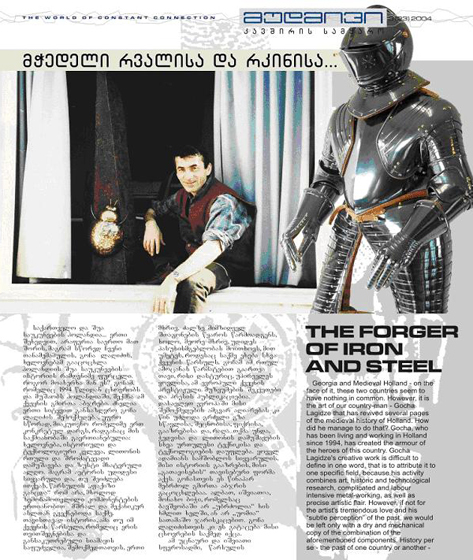
     Gotscha Lagidse is a sculptor from Georgia, the fatherland of iron and bronze, where the art of metal has always been highly respected.
     Georgia lies between the Caspian Sea and the Black Sea on the northern border of Iran, areas which for centuries have been claimed by different peoples: Persians, Turks, Russians and (in the twentieth century) Germans.
     The Georgian desire for freedom and their militant history brought about the development of a rich culture. Until the nineteenth century each family still had its own complete suit of armour on the wall. Metal is part of the culture of this country.
     An enthusiastic teacher fanned the interest of the young Gotscha in historical weapons and armoury. With his inborn talents, knowledge and practical experience grew into a veritable passion for suits of armour, swords and mail coats. At a young age he restored the old armour of his family. By working with and restoring old armours he learned the art of metal. During his studies at the technical university he acquired the title People’s Arts of Georgia. By now Gotscha is recognized both in Georgia and in Europe as one of the most important experts on armour and weaponry.
     Gotscha makes striking miniatures of knights in armour, but he can also create suits of armour, helmets and mail coats in full size. He loves most to work for museums that take care of old armour. In 1998 Gotscha completed a replica suit or armour, after the original personal cavalry armour of Prince Maurits, as ordered by the Dutch Army Museum. The famous ‘stadhouder’ (governor) had this suit of armour made in 1590 – 1595. In this period an improved kind of cavalry armour had just been developed. This only remaining suit of armour of the prince is one of the few authentic suits of armour that have been conserved. It is a real fighter’s armour, sober and light (only forty kilos), in which the rider could easily move.
     The original suit of armour, made in the Netherlands, was given by Maurits to, of all people, the Roman Catholic archduke Ferdinand of Tyrol. Ferdinand was an avid collector of weaponry and armour and in 1601 he published a catalogue of his collection. Maurits’ suit of armour is also mentioned in here. Apparently, despite the Dutch enmity towards the Spanish king Philip II, the protestant Maurits did not feel troubled about a friendship with the Roman Catholic potentate of Vienna.
     In 1998 it was 350 years since the Treaty of Munster ended the ‘Eighty Years War’. The Army Museum placed the suit of armour in an exhibition about the struggle, the tactics and the weapons in this war. It may be that the schoolbooks praise Maurits too highly as a strategist but the great achievement of the prince lies in the training of his armies, until every manoeuvre could be executed faultlessly as by one man, following the example of the Roman legions in the high days of the Roman Empire.
     Gotscha is one or the four or five weapon smiths in Europe that is able to make a historically correct full-size copy of such a suit of armour as that of Maurits. In Georgia Gotscha has worked for museums and private people, but he also worked for the studio of Tsereteli, the man who designed the monument for the building of the United Nations. In Georgia, because of the history of the country, people are above all interested in Gotscha’s exceptional skills as a forger of suits of armour. For a complete mail coat, of which Georgia knows seven different kinds, he connects day after day, for months, little hand forged iron rings into one another, closing each by forging the ends together.
     In 1996 the Maritime Museum on Texel organized a memorial of the Georgian rebellion against the German occupation of the island. Gotscha exhibited a complete full-size suit of armour there. During World War II the Georgians originally chose the side of Germany against the Russians that were occupying Georgia. Georgians came to the island of Texel with the German armies. But there emerged an understanding between the militant Georgians, that had fought to keep their freedom from foreign occupation for so many centuries, and the freedom-loving people of Texel. Eight hundred Georgians rebelled against three thousand German occupiers. 476 Georgians are buried on Texel at a special honorary burial site.
     Apart from weaponry and armour Gotscha shows his artistic gifts in images and sculptures. He has already exhibited his work in Austria. In The Netherlands his work has be exhibited in various places. His sculptures are characterized by a certain lightness. Though made of iron, silver and copper his Ladybirds give the impression to be ready to fly away at any moment. Iron flowers perfectly balanced turn lively towards the sun. Saint Nino (or Nina) is the patron saint of Georgia. She made a cross of vine branches. This gave the Georgian crosses their slightly hanging arms. Gotscha makes Georgian crosses mostly from iron, but also from silver for an altar, or smaller, to be worn on a chain.
     For the ‘Father of the Smith’s Art’ professor Alfred Habermann, Gotscha made a chain of forged rings, on each ring the name of the professor, and on the other side the name of the professor’s wife. Habermann is professor of the European Center for the Preservation of Monuments and Restoration in Venice, without doubt the most important institute in this field.
     Gotscha’s work is remarkable because of his exceptional artistic ability, craftsmanship and specialized knowledge, his care for detail without exaggeration, his highly demanding attitude towards finish, and mostly by his outstanding art. "… I do not draw so much beforehand," he says. "I bring the forms out of the metal as I feel them, without much measuring over and over again. In this way it does happen that pieces are left which cannot be used for anything anymore. Strictly speaking this should not be so, but well, it is just my way of working."


Only this man could copy this suit of armour
Newspaper article (De Volkskrant), by Christie Hoofmeester, 15th December 1998. (translation)


     For ten years the Royal Dutch Army and Arms Museum in Delft searched without success for a smith with sufficient skills to make a copy of the iron suit of armour of prince Maurits from 1590, until G. Lagidse showed himself to be the right man, during an open day of the museum. This Friday his work will be in the museum.
     In his smithy in Den Bosch Lagidse is working with the last leg piece, after 1600 working hours. Hanging on the wall are two mail shirts, helmets and countless photographs of the original armour, which stands in Vienna. The gilded rivets, the 169 parts, the dent in the breast plate, even the fact of the missing back plate and right index finger: Lagidse has copied everything unto perfection.
     He has hardly had a chance to study the original. Nevertheless, the making of suits of armour was his dream. "A suit of armour is the symbol of the power of a nation. From when I was only 14 years old I have occupied myself with warmongery. Dutch suits of armour from the sixteenth and seventeenth century are very famous and graceful."
     Chief curator J. Puype from the Army Museum: "In the whole of Europe I know nobody who is good at smith’s work as well as having such perfect style anatomically. In Georgia people have made suits of armour into the beginning of this century. Lagidse is more than just a tin cutter."
     About the suit of armour that will be exhibited in the Army Museum from January onwards, Lagidse did not worry so much. Only one day in the 1½ years he worked on the metal suit has he doubted if it would come out well. "It was exiting work," he says. "Especially the making of the helmet." The forms of this had to be very precise. "I was occupied with it every day, often started at six o’clock in the morning. And whilst you are working, you do not have to think about it all the time."
     Lagidse would rather not think too much about the future. "I wish to be only positive about that. I am a Georgian artist and I would like to become a Dutch artist as well. I would prefer to make autonomous work, in silver or bronze."


Before it goes I will breathe life into it
Georgian artist makes replica of the suit of armour of prince Maurits, Newspaper article (Brabants Dagblad),
by Mary van Erp, 12th December 2002. (translation)


     He worked on it for months, as if driven by a mysterious force, sometimes continuously for weeks on end. Now it is nearly finished, the replica of the cavalry suit of armour that was worn by prince Maurits around 1590. In the workshop of Gotscha Lagidse (33) it stands robust and stately on its base. As if it could walk away any minute.
     Gotscha comes from Georgia. When still young he became fascinated by the Medieval armours from Asia and Europe. For a hobby he started to copy them and later took to restoration as well. In this way Gotscha became known and he decided to specialize in the art of smiths work.
     On the wall of his workshop hang two mail coats, complete with shield, headdress, weapon gloves and sword. The armour is finished to the tiniest detail. The small rings that form the "knitted pattern" of the mail coat have been connected by means of small holes and nails. A gigantic amount of work for which, apart from craftsmanship, a more than usual amount of patience is necessary. "After visits to museums, the odd exhibition and the sending around of photographs I became somewhat known in the Netherlands," says Gotscha. "During the open day of the Royal Dutch Army and Arms Museum in Delft I came into contact with the main curator Jan-Piet Puype and that brought about this order." For eight months Gotscha worked almost incessantly on his masterpiece. "I knew I could do it, though I had never tried it before," he says proudly. "I was continuously aware of the fact that once upon a time someone else like me had done what I was doing now and that made it very special."
     The specialization of which Gotscha is master, is becoming very rare. According to Puype in the Netherlands there is no longer anyone who is capable of this. "It has always been my dream to have the armour of prince Maurits here in our museum. But it could never be the original. That is in Vienna and is only lent out occasionally. So when the opportunity came, we agreed to it."
     Gotscha has made serious study of the original suit of armour when it was exhibited in the Netherlands. With white gloves and under observation by two cameras he took careful measurements of all 169 parts. The replica is in no way different from the original, which misses the back plate. Also its ‘mark of quality’, the dent from a musket in the breastplate, has been put into it. When all the gilded rivets are in place and the double chiseled lines along the edges have been added, the suit will be ready.
     Meanwhile he has become almost one with his piece of work. It will be difficult for him to have to part with it next week. "They’d better take it away quickly then, but before it goes I will breathe life into it". After this Gotscha wants to leave the making of weaponry for a little while. His next piece will be a ladybird with silver wings. "And preferably in a workshop with living fire."


* * *


      1. დიდი მადლობა ასეთი საინტერესო საუბრისათვის, ისტორიაში შეგვიპატიჟეთ და ახლა ძნელია უკან „მარტივად“ დაბრუნება. ბევრ რამეზე დამაფიქრეთ, ახლებურად შევხედე ქართულ საბრძოლო იარაღს... ღირსეულ საქმეს ემსახურებით, ვაჟკაცურს, შრომატევადს... გოჩა, გისურვებთ წარმატებებს და დიდი მადლობა კიდევ ერთხელ თქვენი დიდი ნიჭისათვის, საქართველოს სახელის პოპულარიზაციისთვის... მზეხა მახარაძის ინტერვიუს მცირე ნაწყვეტში ყველას სათქმელია გადმოცემული. „იმრავლოს საქართველოში გოჩა ლაღიძისნაირმა ნიჭიერმა ხალხმა“. მედეა სიხარულიძე. აშშ.

      2. გიორგი, დიდი მადლობა ასეთი საინტერესო მასალისთვის! გოჩა ლაღიძე კიდევ ერთი დიდი მაგალითია ძლიერი ქართული გენის! ელზა ძაველური. აშშ.

      3. დილაადრიანად „შემოვიარე“ ფერეიდანის „ქუჩები“ და ნიდერლანდებში მცხოვრებ ქართველ ვაჟკაცს, გოჩა ლაღიძეს გადავაწყდი... ამ საიტის საშუალებით არა მარტო ფერეიდანში და დროში, არამედ მსოფლიოს ნებისმიერ ადგილშიც „ვმოგზაურობთ“. გოჩა! იხარე და იდღეგრძელე მრავალჟამიერ! გისურვებ წარმატებებს პირად და საქმიან ცხოვრებაში! ღმერთი იყოს შენი მფარველი! ცისანა ზურგაშვილი. საქართველო. თბილისი.